

Here’s what I’m looking at this week:
Entering Elysium
HyperEVM refresher
What is Elysium?
A few things I tried day one
What I’m excited for
Top 30D DeFi Yields
Let’s jump in.

Before we get into it, I’m a KNTQ holder and an investor in Kinetiq. I staked my entire HYPE airdrop into kHYPE and bought kHYPE YTs during Season 1.
So yeah, I’m sure there’s some bias here. However, I’ve actively tried to add to my position and haven’t sold any of my KNTQ so far.
I mention all that for disclosure, but also because I’ve been following the team and using their products for a while now.
When I first heard the rumors of a Kinetiq L2, I wasn’t particularly bullish on the idea. But that changed pretty quickly as I learned more. HyperEVM has left a lot to be desired, and I could see why builders wanted another option.
A lot of people will judge Elysium on its first few days. I’m more interested in what gets built once the infrastructure is fully in place. I’ll get into where I think the real opportunity is later in this piece.
HyperEVM refresher
First, a quick refresher. Hyperliquid is a blockchain built for onchain trading. Its trading engine, HyperCore, handles spot and perp markets, with everything from order books to trade execution and liquidations happening onchain.
When the Hyperliquid team announced HyperEVM, I was pretty excited.
The interesting part for me was letting apps interact directly with HyperCore. I thought we might see some new products that were only possible sitting next to what I think of as the AWS of liquidity.
This interaction happens through read and write precompiles and a system contract called CoreWriter. Put extremely simply:
Reads let an app on HyperEVM check balances, positions and prices on HyperCore.
Writes let that app take actions on HyperCore, like placing trades or moving funds.
Some of the early stuff Liminal was doing caught my attention, as did Kinetiq’s use of this infrastructure through kHYPE.
But after talking to founders, the feedback I kept getting was that HyperEVM’s capacity made certain apps difficult to run at scale.
That was frustrating. Hyperliquid had built this first class trading product, but builders were struggling to do everything they wanted on the EVM side. From the conversations I was having, scaling it didn’t seem to be an immediate priority either.
So the builders decided to take matters into their own hands.
What is Elysium?
Straight from the docs:
Elysium is a general-purpose, high-performance L2 for Hyperliquid built by Kinetiq. Elysium settles to HyperEVM, uses HYPE as gas, with 100ms blocks and out-of-the-box EVM tooling.
I saw a lot of “why do we need another useless L2?”
I get the sentiment. But this feels like a case where builders actually wanted more capacity than the existing chain could give them.
HyperEVM splits execution between small, frequent blocks and larger, less frequent ones. That leaves limited room for apps that need to update prices or trade constantly.
Elysium is targeting roughly 300 million gas per second, giving things like market making AMMs room to refresh quotes several times a second. It’s still a general purpose EVM chain, so other DeFi apps can build there too.
The interesting part for me is doing that while keeping access to HyperCore’s market data and trading engine, with HYPE still used for gas.
That’s much closer to what originally excited me about HyperEVM. Give builders enough room to experiment next to all that liquidity, and I think we could see some pretty interesting apps.
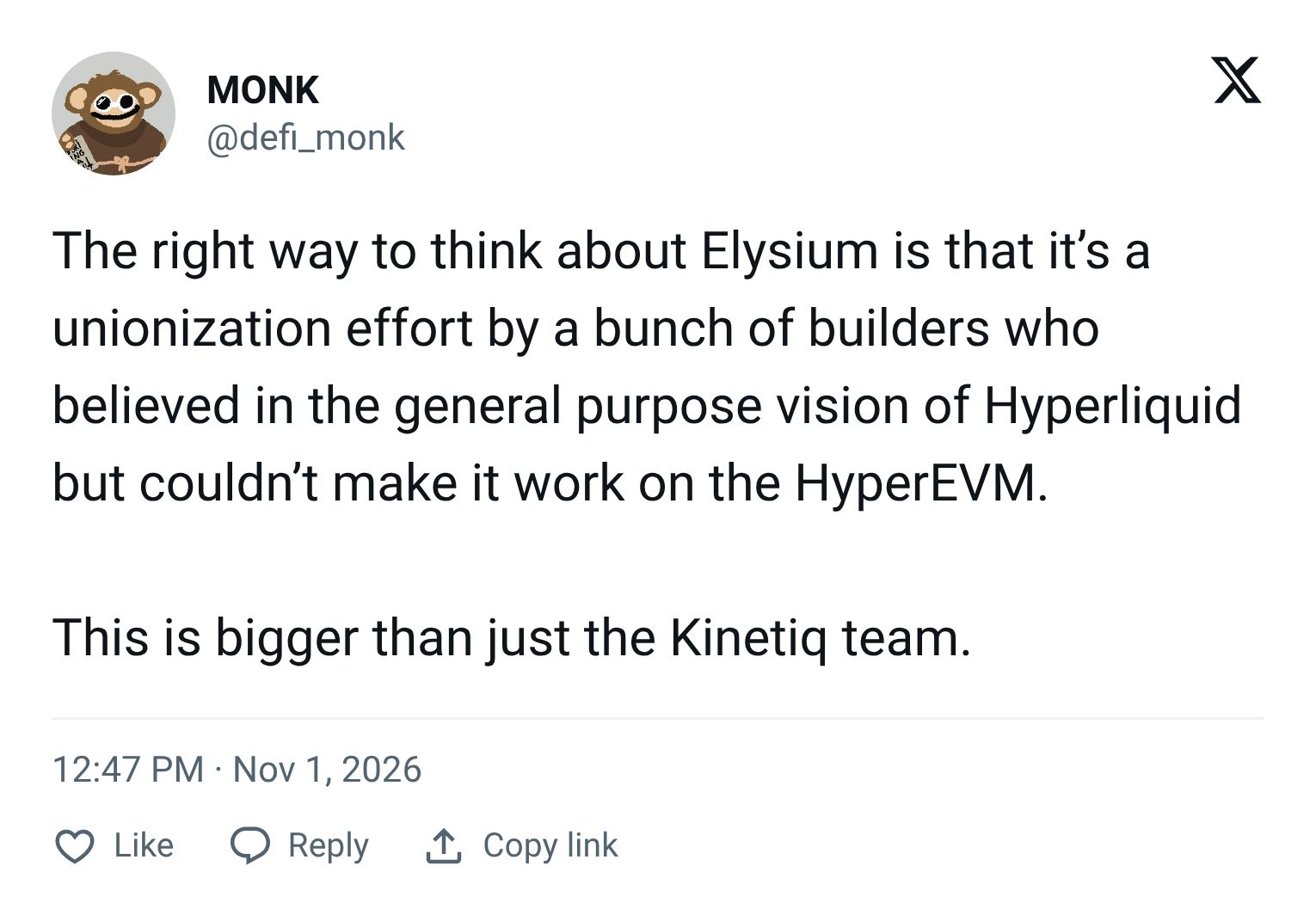
This post from Monk sums things up nicely:
A few things I tried day one
First off, I had to get some HYPE on Elysium so I went the official Elysium website.
The site is actually really well done and a great starting point if you’re trying to navigate what is available or to just learn more about Elysium in general.
Click “Bridge” at the top of the site and this comes up:

Clicking that “Add Elysium to wallet” button also adds the Elysium chain RPC for you.
It took about one minute to bridge, super easy and worked great.
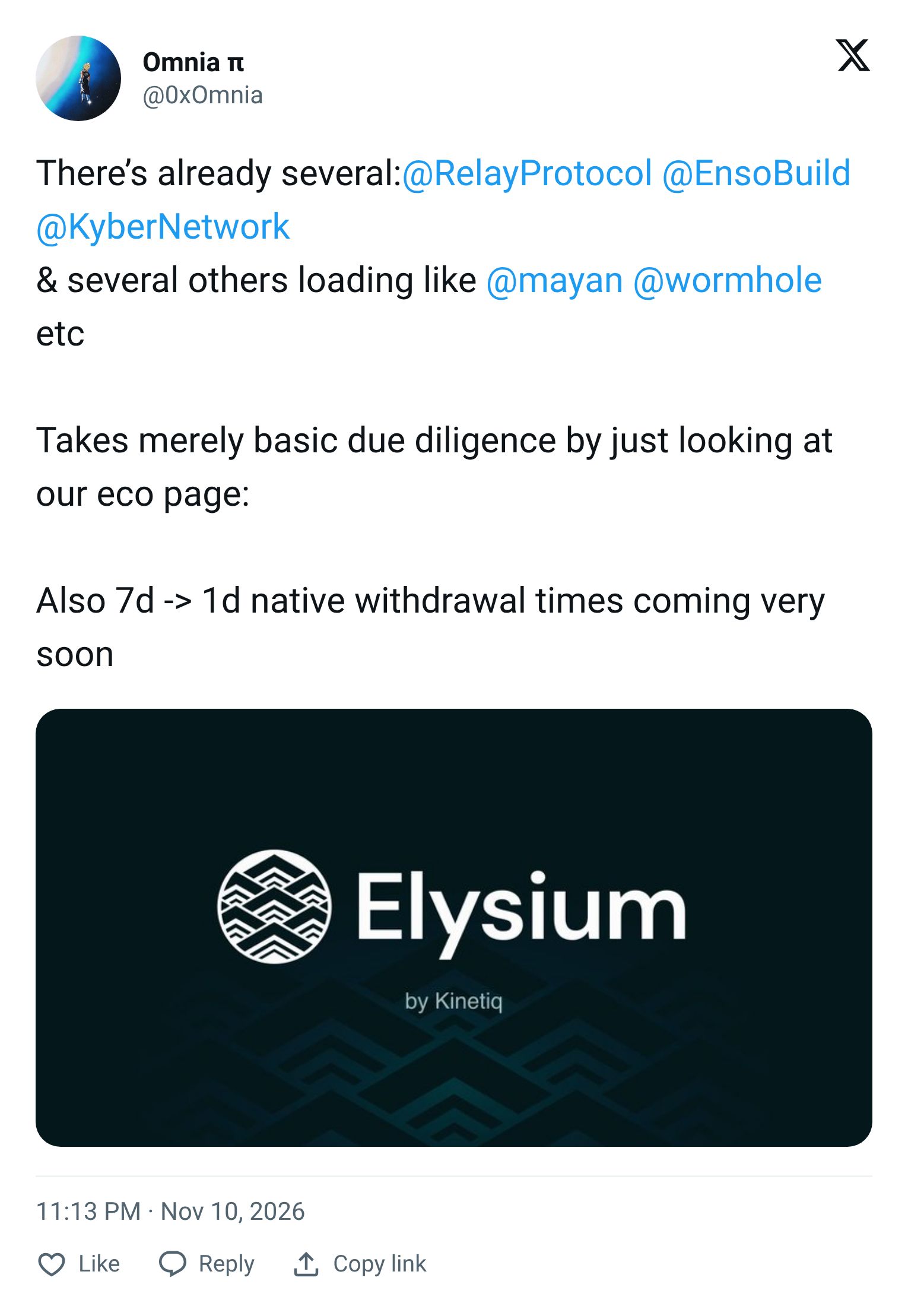
One thing to mention, there’s many bridging partners online and more coming to make bridging back to HyperEVM seamless:
I saw there was a day one Opensea Enter Elysium NFT to mint so I went there to get it, but it was allowlist and I ended up just buying one for cheap.
I’m not sure why me, as a grown man, in my 40s is still minting or buying NFTs, but I thought it was an easy way to test the chain as my first move. And honestly, going to opensea to get an NFT still unlocks some level of nostalgia 😂.
Here it is, it’s actually a video NFT:

I then went over to Ascend as they were making a lot of noise ahead of launch. I’m not going to trade any memes as that’s not my thing, but from an investor standpoint, I wanted to see how volume was on day one. Ascend is one of the teams committed to heavily supporting the KNTQ token:

So here is what volume looked like after first ~12 hours of being live:

Just as I was going to publish, I saw this from Ascend team:
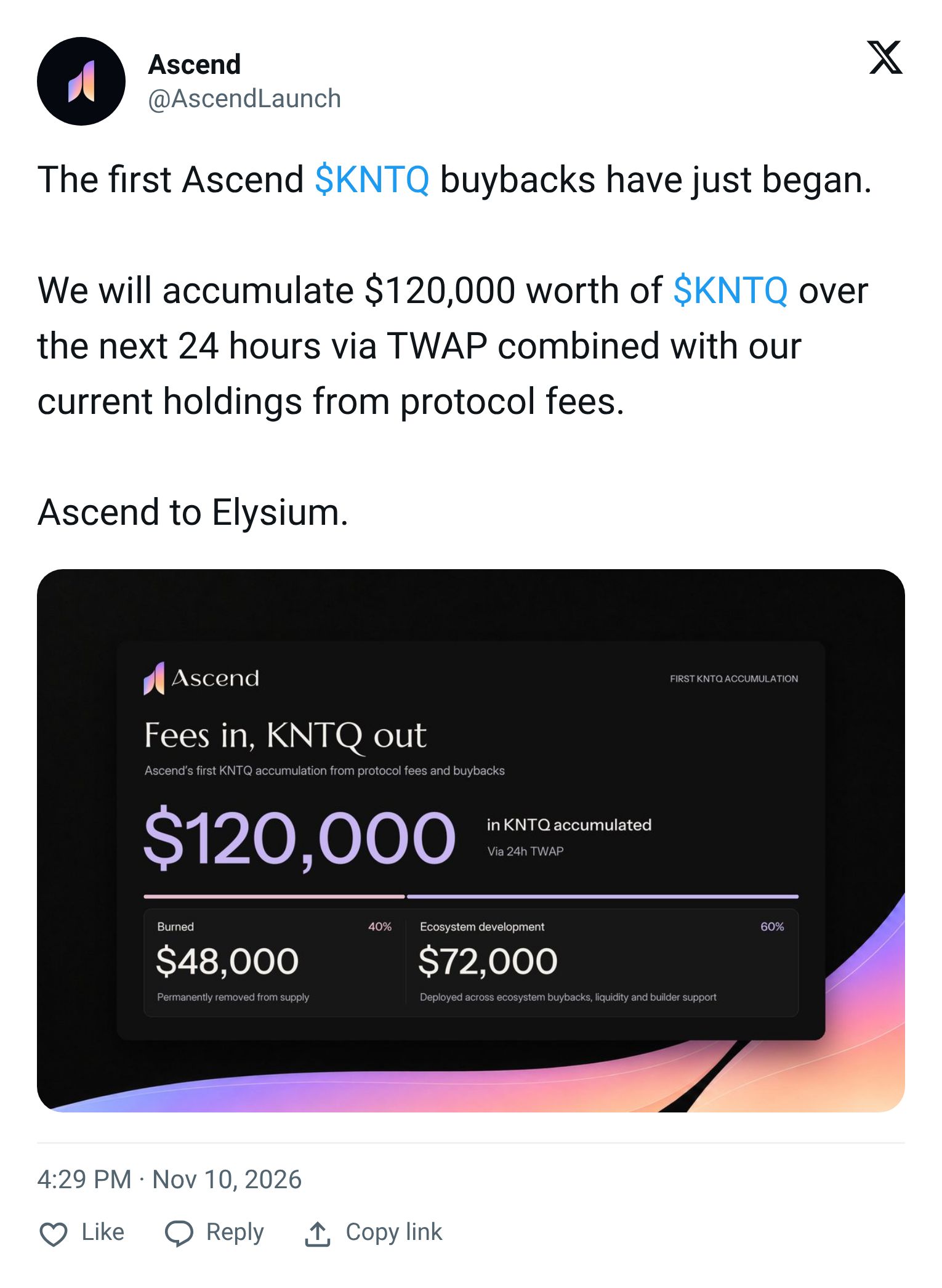
This is actually quite meaningful as there’s fairly low liquidity still on KNTQ 👀
Lastly, one tip for navigating these new ecosystem chains is to just use Definitive. They have day one support for Elysium and if there’s anything really interesting happening I will probably get exposure via Definitive.
Why?
You can setup very custom TWAP or Limit buys and get access to virtually every chain without having to seed a wallet with gas. Also, they get some of the best pricing execution anywhere in DeFi.
What I’m excited for
Omnia lays things out pretty clearly, but I’ll get into this in a bit more detail below:
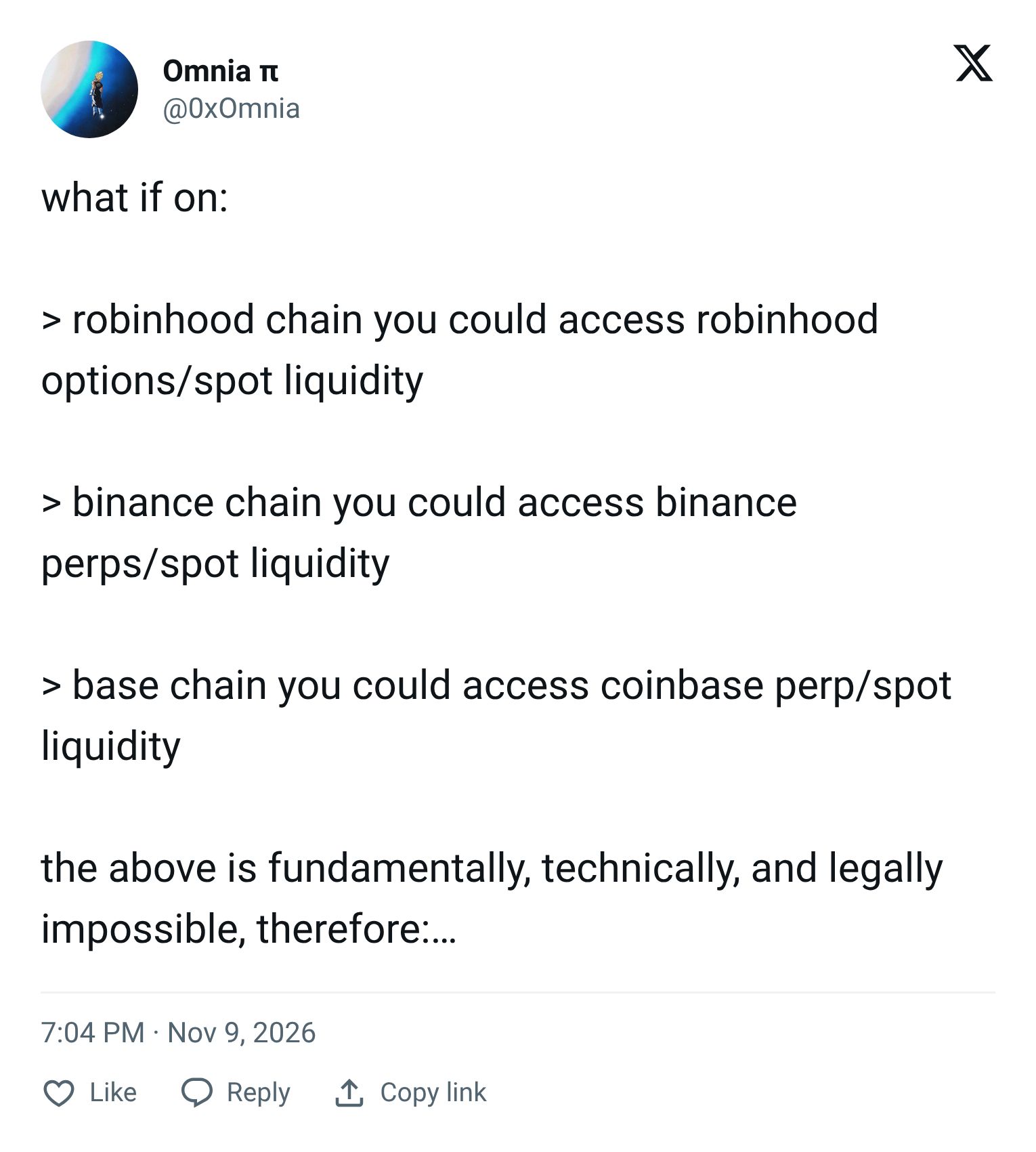
Let’s unpack this tweet above from Omnia a bit more. But let’s use a picture, because I think it makes it all the easiest to understand:

We’ve never really had a scenario like the one laid out in the image above. Which is essentially, a highly performant oderbook and liquidity hub that can also be simultaneously composable with DeFi apps.
Again, this is what originally excited me about HyperEVM. I thought it would lead to interesting use cases and financial primitives we hadn’t seen because they weren’t possible before.
As we mentioned earlier in this piece, it’s the HyperCore read and write ability that unlocks all this functionality.
On day one this is not live as you can see below:

In talking directly to Omnia his estimate is around 4 - 6 weeks.
I think many will judge Elysium on day one or week one memecoin activity, when IMO the real prize here is the new primitives that can be unlocked via HyperCore read and write ability.
The other thing that excites me is the economics of the chain. We overuse the term flywheel, but there’s a very well thought out flywheel in place here for Elysium.
Essentially, sequencer profits generated by the chain go into a few different buckets.
Here’s what the break down looks like:
Destination | Share | For every $100 distributed |
|---|---|---|
KNTQ token buybacks | 50% | $50 |
Apps using Elysium’s blockspace | 25% | $25 |
Kinetiq treasury | 25% | $25 |
If you want to check out how things are going so far you can look look up the sequencer revenue and see it in real-time.
As I wrote this the chain had already brought in $69, 776 in just over 24 hours:

As I mentioned earlier, I think a lot of people will judge Elysium too soon. I’m more interested in what builders can do with Hyperliquid’s liquidity and order books than the memecoin activity or day one stats.
Maybe nothing particularly interesting comes of it. But I’m betting that giving builders more room to experiment unlocks some of the potential that’s been sitting there in the Hyperliquid ecosystem.
Keep reading for a snapshot of DeFi…
Thanks to our sponsors for making it possible to share this content for FREE!


A Look at DeFi Yields
We’re looking at 30 day real yields this week with minimum of $10M in TVL:
Stablecoin Yields
7 day benchmark stablecoin rates from Portals: 3.99%:

Here’s the top yields on stablecoins (real yields) for the past 30 days:

Min $10M TVL
ETH & BTC Yields
7 day benchmark ETH staking rates from Portals: 2.39%

Here’s the top yields on ETH & BTC (real yields) for the past 30 days:

Min $10M TVL
Looping
Here’s a snapshot of the front page of looping this week from yieldz.io (30d APY):

Yield Trading
Taking a look at the front page of Stablecoin yields and RWA yields this week on Pendle:
Stablecoins

11.79% - 26.3%
RWA

14.49% - 26.3%
Thanks for reading!
DISCLAIMER: Nothing written in The Edge Newsletter or said on The Edge Podcast is a recommendation to buy or sell tokens or securities. This content is for educational and entertainment purposes only. Nothing shared here is financial advice. Any views expressed in our content are solely the opinion of that writer, host, or guest. Always do your own research. DeFi Dad, Nomatic, and guests may have positions in the assets or other matters discussed in this content.
Follow Nomatic on X (Twitter) here

